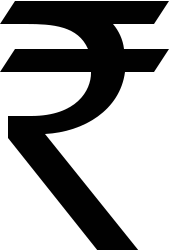
The Indian rupee symbol (₹) has a fascinating history, but many myths surround its adoption, design, early usage, and selection. Here’s the accurate timeline, clarifying what actually happened:
- Early 2009 – Designing the Symbol
– The ₹ symbol was designed by Dr. Udaya Kumar in early 2009.
– Myth busted: Some sources mistakenly claim the design was created in 2010. The actual design existed well before the official selection. Some also say the “Rupee Symbol competition of 2010,” but the competition actually began on 5 March 2009 and ended on 15 April 2009. Only the result was declared in 2010. - 15 July 2010 – Selection as the Winner
– The symbol was officially selected as the winning design from among numerous entries. At that time, and until 12 October 2010, it was not usable—neither by the government nor by citizens.
– On this day, Finance Ministry officials announced:
“The symbol will be adopted in a span of six months in the country, and within 18 to 24 months globally,” Soni said, adding that it would feature on computer keyboards and software for worldwide use.
– Myth busted: Many assume the symbol was officially adopted on 15 July 2010.
– Fact: Selection is different from adoption; the symbol was only chosen at this point.
It was not possible to use the symbol at this time, and the Finance Ministry did not announce that India was adopting it immediately. They clearly stated that adoption would take place within six months. Something not yet in actual use cannot be considered adopted. Selection is not the same as adoption. - 12 October 2010 – Real Adoption & Official Use
– Unicode 6.0 was officially released on 11 October 2010 (PDT), and became available in India on 12 October 2010 due to the time zone difference (UTC+5:30). This update included emojis for the first time and also the ₹ symbol at code point U+20B9.
– Before this date, India used either “Rs.” or the older ₨ (U+20A8) in both handwritten and printed/digital documents.
– Because of Unicode standardisation, “Rs.” gradually began being replaced with “₹” in government documents, banks, reprinted NCERT books (once older stock ran out), utility bills, and Hindi documents that previously used “रु”.
– This marks the first practical de facto adoption of the rupee symbol in India, and the beginning of its use in government documents.
– While “Rs.” continued to be used widely even after this date, from 12 October 2010 onward it finally became possible for anyone to use the new symbol. This marks true adoption in the digital world through Unicode, and also encouraged domestic use. Prior to this date, the symbol could not be typed or used digitally, and most people were unaware that a symbol had even been selected. After this date, awareness increased, and usage spread.
– Myth busted: The selection date (15 July 2010) is often incorrectly cited as the adoption date. The true adoption/release/launch date is 12 October 2010. - 8 July 2011 – Adoption on Physical Currency
– Prior to 8 July 2011, a circular issued by the Reserve Bank of India on 8 December 2010—one of the earliest government documents using the ₹ symbol—featured the upcoming design of the ₹5 coin marking the Birth Centenary of Mother Teresa. This coin did not yet show the ₹ symbol but confirmed that the symbol would soon appear on currency. This was again reaffirmed by Finance Minister Pranab Mukherjee on 28 February 2011.
– The symbol appeared for the first time on Indian coins when the new series was introduced. Until around November 2010, the older 50 paise Hasta Mudra and Common Circulation Series coins (without ₹) continued to be minted. ₹1 and ₹2 coins from the Hasta Mudra Series (without ₹) continued until early 2011.
– Until 30 June 2011, all coins of 25 paise and below were legal tender. They were demonetised on 1 July 2011, effectively discontinuing the paisa currency. Paise coins never carried the ₹ symbol because they lost legal tender status before the symbol was introduced. Their discontinuation may have been related to avoiding redesigning them, but they were also a different unit altogether.
– Myth busted: Many believe that the symbol appeared on currency immediately after July 2010. In reality, it first appeared on coins only in July 2011. July 2010 was not the adoption date.
– New banknotes with the ₹ symbol were introduced in stages:
1. ₹10 note: 23 September 2011
2. ₹20 and ₹50 notes: 12 April 2012
3. ₹100 note: 18 January 2012
4. ₹500 note: 26 December 2011
5. ₹1000 note: 18 November 2011
– The ₹5 note was never printed with the symbol; its printing ended in 2011. - Kaun Banega Crorepati Season 4 – Early Usage (11 October 2010)
– The show premiered at 9:10 PM IST.
– Initially, the logo still showed four “Rs” instead of “₹”.
– After the first commercial break (around 9:30 PM IST), the logo was updated to display six ₹ symbols. The video-wall logo was pre-recorded, so the symbol appeared as an image rather than typed text, since adoption had not yet occurred. This parallels a similar case in France (below).
Fun fact: Cheques signed by Amitabh Bachchan in early episodes still used “Rs.” because those episodes were recorded earlier.
– Comparison to France:
France’s quiz show “Qui Veut Gagner Des Millions?” displayed prize amounts in euros in late 2001, even before the euro’s official adoption in January 2002. Similarly, KBC Season 4 showcased the ₹ symbol in advance of its actual adoption on 12 October 2010.
Summary of Key Dates:
- Design: Early 2009
- Winner Selected: 15 July 2010 (selection, not adoption)
- Digital Adoption & Start of Government Use: 12 October 2010
- Adoption on Physical Currency: 8 December 2010 (first official reveal); July 2011 (actual appearance on coins)